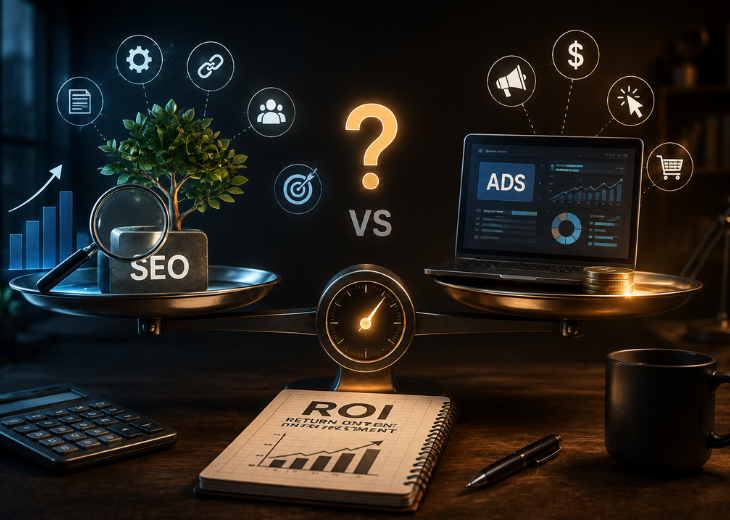
Every small business owner I have spoken with this year has asked some version of the same question. Should I invest in seo services for my website, or just run Google Ads and be done with it. Both channels genuinely work, just not on the same timeline, budget, or terms. After running both sides of this for clients across the US, UK, and India at StepNgroow, my honest answer is that the better channel depends on how long you can wait for results and how much cash you can afford to spend before your first lead.
SEO vs PPC: What Actually Separates Them
SEO earns visibility in organic results and AI generated answers through better content, technical health, and relevance signals. Paid ads, run through Google Ads, Meta, and LinkedIn, buy visibility directly. Neither is inherently better, one is rented, the other is built. A 2026 update to Sagapixel’s SEO vs PPC research found small and medium businesses still spend roughly seven times more on PPC than SEO, mostly because paid ads feel more controllable and immediate, meaning most are underinvesting in the channel that actually compounds.
Is PPC Better Than SEO?
Not universally, and anyone who claims otherwise is usually selling one of the two services. PPC wins on speed and control, SEO wins on cost efficiency and durability. The same Sagapixel dataset shows organic search converting at around 2.4 percent, nearly double the 1.3 percent typical PPC rate, largely because organic visitors arrive already trusting a result they were not shown as an ad. PPC is better when you need leads this month. SEO is better when building something meant to still generate traffic three years from now.
Is SEO Worth It for Small Businesses?
Yes, for most small businesses, and the data backs it rather than just agency opinion. SEOProfy’s 2026 SEO ROI benchmarks show local SEO generating average returns of up to 700 percent within 6 to 12 months, with organic leads closing at roughly 14.6 percent compared to around 1.7 percent for outbound marketing.
Two examples most readers already know make the point well. Airbnb built a large share of its early growth on programmatic SEO, creating thousands of location pages long before it had a public company’s ad budget. HubSpot built its entire acquisition engine on content and organic search rather than paid media, a case study still taught in marketing courses today. Neither treated SEO as optional. They treated it as the foundation everything else sat on.
Factor | SEO | PPC / Paid Ads |
Time to first results | 3 to 6 months, sometimes longer for competitive niches | Same day to a few hours after launch |
Cost behaviour | Upfront investment, then compounds and gets cheaper per lead over time | Ongoing cost, resets every month, stops the moment budget stops |
Average conversion rate | Around 2.4% | Around 1.3% |
Trust factor | Higher, users see it as earned, not bought | Lower per click, but strong for high intent, bottom funnel searches |
Best for | Long term brand equity, content authority, AI search visibility | Launches, sales, testing offers, filling short term pipeline gaps |
Risk if you stop | Traffic dips slowly, most gains stay | Traffic drops to zero almost immediately |
What the 2026 Numbers Actually Say About ROI
Here is where it gets concrete. WordStream’s 2026 Google Ads benchmark report, based on more than 13,000 campaigns, puts the average cost per click across industries at 5.42 US dollars and the average cost per lead at 66.69 US dollars. A case study from Codivox’s 2026 PPC vs SEO analysis describes a US plumbing company spending 4,200 dollars a month on Google Ads for about 35 leads at roughly 120 dollars per lead. Reasonable on paper, but when the business paused ads for two weeks during a cash crunch, leads dropped to zero overnight. Their pipeline was rented, not owned, a risk paid advertising agency india clients rarely get warned about upfront.
This is the biggest argument for building SEO alongside any performance marketing agency india engagement. Paid channels convert demand that already exists, they build very little that keeps working after the invoice is paid.
How Much Should a Small Business Pay for SEO?
It depends on your market and ambition, not a fixed number. Roughly, for businesses looking at seo packages in india:
- Single city businesses: modest retainers for Google Business Profile and local seo services india content
- Growing regional brands: mid range affordable seo packages covering technical SEO and link building services in india
- Ecommerce and multi location brands: higher investment covering ecommerce seo services india and digital PR
Our rule at StepNgroow: if a quoted seo cost per month in india cannot cover strategy, technical fixes, and consistent content every month, it will not move rankings, however affordable it looks on paper.
What Is the 80/20 Rule for SEO?
Roughly 80 percent of ranking gains come from a small set of fundamentals: technical health, matching real search intent, solid on page structure, and a handful of genuinely useful pages. The remaining 20 percent comes from more advanced, marginal tactics. Whenever a client assumes they need something exotic, we start with that boring 20 percent first, since it delivers 80 percent of the outcome.
When Paid Ads Are Genuinely the Smarter First Move
None of this means SEO always comes first. A good ppc agency india partner will tell you honestly when PPC advertising management is the smarter starting point:
- Launching a brand new product with zero search history or existing demand
- Running a time boxed sale that needs traffic this week, not this quarter
- Testing offers quickly through a google ads agency india campaign before committing to content
- Retargeting ads for ecommerce india to recover cart abandoners, or linkedin ads agency india campaigns for B2B lead generation by job title
SEO, AEO, and GEO: The Search Reality in 2026
Search itself has changed. Answer engine optimization, or AEO, structures content so Google AI Overviews, ChatGPT, and Perplexity can lift it directly into a generated answer. Generative engine optimization, or GEO, goes further, focused on getting cited inside AI responses rather than just ranking on a results page. The aeo vs seo difference in one line: SEO earns a position on a results page, AEO and GEO earn a mention inside the answer itself, sometimes without a click. That is why we now scope AEO and GEO into most seo and aeo agency india engagements by default.
We went deeper into what actually drives AI citations in our own breakdown of digital PR in the AI search era, including data showing a large share of AI Mode citations do not even come from pages ranking in the traditional top 10. Ranking number one on Google no longer guarantees you show up when someone asks the same question in ChatGPT or Gemini. If you want to know how to rank in ai answers india audiences increasingly rely on, start with the same SEO fundamentals above, layered with clear, quotable content built for optimize for featured snippets india extraction and voice search optimization services india use cases.
My honest take: I do not think this is really an SEO versus PPC argument anymore, it is a patience versus cash flow argument. Runway for four to six months, SEO plus AEO plus GEO is the better long term bet. Need revenue in the next thirty days, paid ads are the correct call, not a compromise.
The Combined Approach That Actually Wins
Businesses that grow fastest in 2026 rarely choose one channel exclusively. They run a full funnel ad strategy agency mindset, paid search filling the pipeline today while organic and AI search visibility build for the next three years:
- Audit organic visibility and technical health before spending on ads
- Run a lean google ppc management campaign on high intent keywords for immediate cash flow
- Reinvest early ad revenue into content and link building services in india
- Layer AEO and GEO structuring into every new page from day one
- Track cost per lead across both channels and shift budget toward whichever converts
This blended model is essentially what we structure into StepNgroow’s Takeoff Package for growing businesses, and the more advanced Airglide Package for brands ready to run SEO, paid media, and automation as one connected system.
The Bottom Line
If you can only fund one channel this quarter, look at your runway before the benchmarks. Cash constrained and need leads by Friday, paid ads win. Building something meant to still work in three years, SEO wins, by a wider margin every year AI search grows. Most small businesses do not need to choose, they need a partner who can run both without treating them as competing budgets.
That is the approach we have built at StepNgroow Pvt Ltd, a full service digital marketing agency working with brands across the US, UK, UAE, and India. We do not sell SEO and paid ads as separate products competing for the same budget, we plan them as one growth system, alongside the AEO and GEO layer that decides whether AI powered search sends a customer your way or to a competitor. Get in touch through stepngroow.com and our team can look at your traffic, ad spend, and search visibility to tell you honestly where your next dollar or rupee works hardest.
Is PPC better than SEO?
Neither is universally better. PPC is better when you need leads within days and have budget to spend continuously. SEO is better for long term, compounding, lower cost per lead results, but it takes months to build.
Is SEO worth it for small businesses?
Yes, for most small businesses. Local SEO alone can generate returns of up to 700 percent within 6 to 12 months, and organic leads typically close at a higher rate than outbound or cold paid leads.
How much should a small business pay for SEO?
It depends on market size and competitiveness, but a workable seo package usually covers technical fixes, ongoing content, and basic link building every single month. Anything priced too low to cover those three rarely moves the needle.
What is the 80/20 rule for SEO?
It means roughly 80 percent of your ranking gains come from getting a small set of fundamentals right, technical health, search intent match, and solid on page content, rather than from chasing advanced or niche tactics.
What is answer engine optimization (AEO)?
AEO is the practice of structuring content so AI tools like Google AI Overviews, ChatGPT, and Perplexity can extract and cite it directly inside a generated answer, rather than only ranking it on a results page.
Can a small business run SEO and PPC at the same time?
Yes, and it is usually the smartest approach. PPC covers the gap while SEO is still ramping up, and profits from paid campaigns can be reinvested into content and technical SEO that keeps working long after the ad budget is spent.
How long does SEO take to show results for a small business?
Most small businesses start seeing meaningful movement between month three and month six, with stronger compounding results after month nine to twelve, depending on competition and starting point.