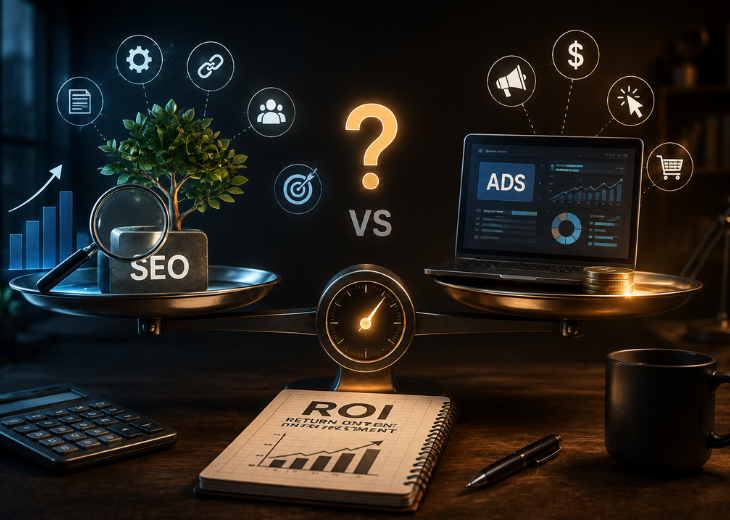
Every business owner hits the same fork in the road. You have a budget, a product worth selling, and limited hours in the week. So where should it go: building an audience through social media marketing, or buying attention through paid advertising? The honest answer is that social media marketing vs paid advertising is not a fight where one wins forever. It is a balance, and in 2026 that balance has shifted in ways most small businesses have not caught up with yet.
Quick answer: In 2026, social media marketing builds long-term trust and compounding organic reach for a low cash cost but a high time cost, while paid advertising buys fast, measurable traffic and leads for a higher and rising cash cost. Most growing businesses win by combining both: organic social to warm the audience, and paid advertising (including PPC) to convert demand on a schedule. Neither is universally “better.” It depends on your timeline, margins, and how much content you can sustainably produce.
What Does Social Media Marketing Do?
Social media marketing grows a brand by publishing content and building relationships on platforms like Instagram, TikTok, LinkedIn, Facebook, and YouTube. It does four jobs at once: it puts your brand in front of new people, builds trust through consistency, creates a direct line to your audience through comments and DMs, and builds a content library that keeps working after you publish.
The scale is huge. Meta reported around 3.56 billion daily active people on average for March 2026, up 4% year over year, and LinkedIn now has 1.3 billion members. Instagram is the most used platform among marketers at 70%, with Facebook close behind at 69.6%.
A famous example most people know is Duolingo, whose chaotic owl mascot grew tens of millions of TikTok followers without paying for that reach. That is social media marketing earning attention instead of buying it. In India, Zomato and CRED do the same through witty, meme-style posts that get shared organically.
The 2026 Reality: Consistency Now Beats Going Viral
The dream of a single viral post has flipped. Per a 2026 analysis of millions of observations, one viral post is now worth roughly a quarter of its 2023 value, while a steady weekly cadence is worth four times more. Instagram head Adam Mosseri confirmed the platform’s four ranking signals in April 2026: DM shares, saves, watch time, and profile clicks.
The data is striking. Buffer’s 2026 report found average Instagram engagement fell from 7.3% to 5.4%, a 26% drop, partly because likes were down-weighted as a ranking signal. Accounts that go quiet also pay a price: even one silent week causes a measurable “no-post penalty,” with small accounts needing two to six weeks to recover. On TikTok, accounts posting across more than three unrelated topics see an average 45% reach drop versus single-niche accounts.
The lesson for 2026: pick a clear niche, post on a steady schedule, and treat replies as part of the algorithm’s input. (See our internal guide on content marketing strategy.)
Platforms Are Handing the Algorithm to Users
One more 2026 shift matters. As of June 2026, Instagram and Threads launched features called “Your Algorithm” and “Your Algo” that let users pick the feed they want by topic, while TikTok has offered a “Manage Topics” slider since 2024 plus Smart Keyword Filters. The takeaway: pivot away from broad appeal toward hyper-targeted niche audiences, and be deliberate with themes and metadata so your content lands in the right feeds. Clarity about what you are “about” matters more than ever.
What Is Paid Advertising?
Paid advertising is any marketing where you pay a platform to place your message in front of a chosen audience. It includes pay-per-click (PPC) search ads on Google, shopping ads, display, YouTube ads, and paid social on Meta, LinkedIn, and TikTok. Instead of waiting for organic reach, you buy it directly.
The defining feature of paid advertising is control and speed. You can launch today and have qualified visitors within hours, with exact figures for what each click and conversion cost. That is why a strong ppc advertising management process sits at the center of performance marketing: it lets you test offers, scale winners, and shut off losers quickly, something organic cannot do on demand.
A recognizable example is searching “running shoes” on Google and seeing Nike, Adidas, and retailers at the top with a “Sponsored” label, bought through Google Ads. Amazon’s product search runs on the same model. For Indian businesses, ppc advertising india has matured the same way: D2C brands like boAt and Mamaearth scaled by pairing strong creative with disciplined paid search.
How to Start Paid Advertising
- Define one measurable goal (leads, sales, calls, or sign-ups). One goal per campaign keeps reporting honest.
- Match platform to intent. Use Google PPC when people actively search for what you sell; use paid social to create demand by interest or behavior.
- Set a test budget for at least 30 days. Algorithms need data; stopping early wastes the learning phase.
- Align ad to landing page. In 2026 the bottleneck is rarely the ad: CTR rose while conversion rates fell in 13 of 14 industries, so the problem has shifted to landing pages.
- Track weekly. Watch cost per click, conversion rate, and cost per acquisition together, never in isolation.
When doing this well in-house becomes the constraint, a specialist ppc agency india earns its fee through structured google ppc management and continuous testing.
What Is the Difference Between Social Media Marketing and Paid Advertising?
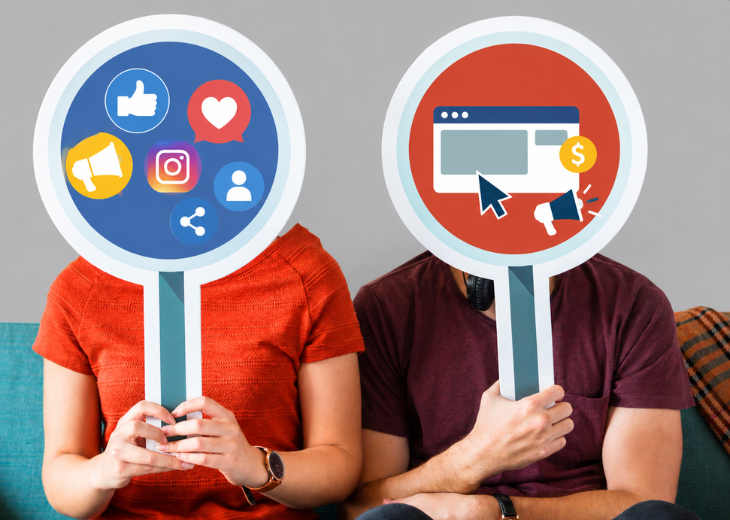
The core difference is earned versus bought attention, and long-term versus immediate results. Social media marketing earns reach over time through content and community, with low cash cost but high time cost. Paid advertising buys reach instantly through ad spend, with higher cash cost but near-instant, measurable results.
Factor | Social Media Marketing (Organic) | Paid Advertising (incl. PPC) |
|---|---|---|
Primary cost | Time and content | Ad spend, per click or result |
Speed | Weeks to months | Hours to days |
Longevity | Compounds over time | Stops when budget stops |
Measurability | Improving, fuzzier | Precise and trackable |
Trust building | Very strong | Moderate |
Best for | Brand, community, retention | Fast leads and sales |
Both are growing as a share of budgets. Dentsu forecasts social advertising will grow 11.4% in 2026, and that digital will account for 68.7% of total ad investment in 2026.
Organic Social Media Marketing vs Meta Ads
Organic social on Meta means posting Reels, carousels, and Stories for free. Meta ads mean paying to target precise cold and warm audiences. The 2026 trade-off: organic reach is harder as engagement dropped, but Meta ads are pricier too. Meta reported Q1 2026 ad impressions up 19% year over year while average price per ad rose 12%. The smart loop most brands use: test messages organically, then put paid budget behind proven winners. Your best organic Reel is often your cheapest, highest-converting ad.
Is PPC Better Than Social Media Marketing?
PPC is not universally better; they solve different problems. PPC, a form of paid advertising, is better when you need to capture existing demand fast and measure return precisely. Social media marketing is better when you need long-term brand awareness, trust, and an owned audience that lowers future ad costs.
The case for PPC in 2026 is intent. When someone types “emergency plumber near me” or “ppc agency india,” they are ready to act. The cross-industry average Google Ads conversion rate rose to around 4.40% in 2026. But intent is getting pricier: average search CPC rose 12% year over year to $2.96 in Q1 2026, partly because Google’s AI Overviews cut organic clicks and pushed more businesses into paid search.
The case for social media marketing is durability. Paid traffic vanishes when you pause spend; a strong organic presence keeps delivering, and a warm audience makes every future ad cheaper. That is why disciplined ppc advertising management and consistent organic content are partners, not rivals.
One note on TikTok: it is now a search and shopping engine, with 84% of TikTok searches happening in the exploration phase and TikTok Shop sales forecast to reach $23.41 billion in 2026. Watch time and the first three seconds drive both organic and paid performance there.
So, Which Is Better for Your Business?
Start with social media marketing if: you have more time than cash, your product needs trust or community, and you can post consistently for 90+ days.
Start with paid advertising and PPC if: you need leads this month, people already search for what you sell, and your margins can absorb a rising CPC.
Use both (best for most growing businesses) if: you want fast results now and compounding growth later. Let google ppc management capture demand while social media marketing builds the brand that makes those ads convert more cheaply.
For most businesses in 2026, the answer to social media marketing vs paid advertising is “both, in the right ratio.” A good ppc agency india or marketing partner sets that ratio around your margins and goals, not a template.
Conclusion
Stop treating this as either/or. Social media marketing builds the trust and owned audience that make your brand resilient, especially now that consistency beats virality. Paid advertising, led by well-managed PPC, buys speed and measurable returns. The businesses pulling ahead run both as one system: social media marketing to create demand, paid advertising to convert it, with disciplined ppc advertising management keeping every rupee accountable. Whether in-house or with a ppc agency india, the move is the same: build the audience, capture the intent, measure relentlessly.
Ready to map the right mix? Our team can audit your channels and build a plan balancing organic growth with high-performance ppc advertising india. Start with a free strategy call.
What is the main difference between social media marketing and paid advertising?
Social media marketing earns reach over time through organic content and community, with low cash cost but high time cost. Paid advertising buys reach instantly through ad spend, delivering fast, measurable results at a higher and rising cash cost. The two work best together.
Is social media marketing or paid advertising cheaper?
Social media marketing has a lower direct cash cost since organic posting is free, but it demands time and consistency. Paid advertising costs money per click and is rising; the average Google Ads search CPC hit around $2.96 in early 2026, up 12% year over year. Cheaper depends on whether your scarce resource is money or time.
Should a small business start with PPC or social media marketing?
If you need leads quickly and people already search for your product, start with PPC and paid advertising. If you have a tight budget, a longer timeline, and a trust-driven product, start with social media marketing. Many begin with a small PPC test while building organic content in parallel.
Why is paid advertising getting more expensive in 2026?
Costs are rising due to more competition, wider AI-driven Smart Bidding, and Google’s AI Overviews reducing organic clicks, which pushes more businesses into paid search. As a result, conversion rate and landing-page quality now matter more than a low cost per click.
Can I do social media marketing and paid advertising at the same time?
Yes, and for most growing businesses that is the strongest approach. Use organic social to test which messages resonate, then put paid budget behind your winners. Organic builds the audience that makes ads convert cheaper, while paid delivers the fast, predictable results organic cannot guarantee.
Does professional PPC management actually improve results?
Often yes, because structured PPC advertising management focuses on the levers that matter: tight targeting, ad-to-landing-page alignment, and continuous testing. With CPCs rising and conversion rates slipping industry-wide, disciplined Google PPC management protects return on ad spend an unoptimized account would lose.